VISIT FOR THE BEST FITNESS AND HEALTH ADVICES

Blog Archive

Thursday, July 17, 2025

The NEW Beginner Dumbbell Workout (Plus my favorite dumbbell exercises 💪)


If you’ve ever picked up a pair of dumbbells, looked around, and thought:

“Uhhh… what do I do with these?”

Or maybe, you just want to know a quick, safe, and effective workout to get stronger, build muscle, and improve body composition.

In either case, I got you! 🙌 Today, in the spirit of our most popular blog post of all time, I’m giving you a Beginner Dumbbell Workout you can do at home or at the gym, plus a list of my favorite dumbbell exercises and answers to the most common questions we get from readers and Nerd Fitness Coaching clients.

Let’s get into it 👇

🏋️‍♀️ Beginner Dumbbell Workout

Do this 2–3x per week with a rest day between each session:

Exercise #1: Goblet Squats – 3 sets of 8–12 reps

Exercise #2: One-Arm Dumbbell Rows – 3 sets of 8–12 reps per arm

Exercise #3: Dumbbell Floor Presses – 3 sets of 8–12 reps

  • Have a bench lying around? Feel free to switch this to a dumbbell chest press!
  • To get a bit more range of motion, try doing this while holding a glute bridge at the same time, or resting your upper back and head on a long foam roller.

…and that’s it. Three exercises that are big “bang for your buck” movements, and you’ve got yourself a workout! 🙌

A couple of other things to keep in mind:

👉 Rest 60–90 seconds between sets. Focus on slow, controlled movement on the way down, and then smooth and athletic movement on the way up.

👉 Warm up with some arm circles, bodyweight squats, and light cardio (marching in place works great), and then do a few reps of each exercise with a lighter weight (if you have one) or just with the weights you have to get your body moving and ready to workout.

👉 Once these start to feel easier? Increase reps, increase the weight, slow down the tempo, or add 1 or 2 more exercises to your circuit.

🎯 My Favorite Dumbbell Exercises

When you’re ready to mix things up or go deeper, here’s your go-to list of awesome dumbbell moves:

🔽 Lower Body

🔼 Upper Body Pull

🔼 Upper Body Push

🧩 Accessory Lifts

⚡ Power Moves (for full-body strength & conditioning)

No machines, no problem.

You can build a complete and effective strength routine with just one or two dumbbells and some floor space.

🤔 Common Dumbbell Questions (answered!)

Q: I only have one set of dumbbells. What do I do?

A: No worries! The key is adjusting your reps and variations.

If you can do 20+ reps with ease, it’s time to:

  • Add a tempo (like 3 seconds down)
  • Do single-leg or staggered-stance versions
  • Reduce your rest between sets
  • Add another 1-2 exercises from the selection to your circuit.

There are tons of ways to make things harder without heavier weights. Just like you can make your bodyweight exercises harder by changing the leverage angle or progressing to a more challenging variation, you can do the same even with a limited weight selection!

Q: Will dumbbells make me bulky?

A: Not unless you’re trying really hard to bulk up.

This concern pops up a lot, but the reality is:

Building visible muscle takes years of consistent training, lots of food, great sleep, and favorable genetics.

What will happen: you’ll build strength, improve joint and tendon health, and help prevent osteoporosis (especially important for women in peri-menopause and beyond).

Q: What weight should I start with?

A: Ultimately, you want a weight where the last 2–3 reps feel challenging, but doable with good form.

As a general rule of thumb, always start with less weight than you think. It’s always easier to progress when something feels too easy than to back off once you’ve overreached. You can use it to warm up and feel out the movement. As you get more experience with dumbbells, you’ll know what weights you used last time and when to push yourself a little harder (though you still want to make sure you do a warm up round!)

Too easy? Go heavier or add reps. Too hard? Go lighter or reduce reps.

Your form is always the priority. Strength gains follow. Still unsure if you are lifting enough weight? Read this.

Q: How long should a dumbbell workout take?

A: 20–30 minutes is plenty when you’re starting out.

If you’re short on time, even one solid set of each exercise is better than nothing. You can always build from there.

Q: Do I need to do cardio too?

A: Dumbbells can be your cardio (or at least, a part of it!)

Moves like thrusters, snatches, and skier swings elevate your heart rate and build muscle. Heck, any dumbbell exercise can elevate your heart rate if you perform the reps on a timer. Try one of these options: Level 1: 30 seconds of work with 60 seconds of rest between each exercise for 3-5 rounds.

Level 1: 30 seconds of work with 30 seconds of rest between each exercise for 3-5 rounds. Level 2: 40 seconds of work with 20 seconds of rest between each exercise for 3-5 rounds. Trust me, you’ll feel your heart rate getting up there. 😬

But if you love walks, bike rides, or dance breaks? That counts too. Just move.

🧠 Final Thought

You don’t need a perfect plan to get started. You just need a plan that’s simple, sustainable, and repeatable.

Dumbbells are one of the best tools for strength training beginners because they’re:

✅ Versatile

✅ Accessible

✅ Scalable

So pick up those dumbbells. Try the beginner workout. Then reply to this email and let me know how it goes!

If you want help building your own plan, our 1-on-1 coaching program does that and so much more: guidance for how to get started, accountability when you aren’t feeling motivated, and a plan built specifically for you, your goals, and your life. See which coach would be a great fit for you with our quick quiz.

You got this!

Coach Matt

P.S. Have other questions about dumbbells, getting started with exercise, or anything else? Shoot them my way!  

The post The NEW Beginner Dumbbell Workout (Plus my favorite dumbbell exercises 💪) first appeared on Nerd Fitness.


from Nerd Fitness https://ift.tt/JoQFKAI

Monday, July 14, 2025

Why falling off track is a GOOD thing


You ever feel like you were finally getting into a good groove with your workouts, only to have life knock you sideways?

Good. That’s how it works.

No, seriously.

In Nerd Fitness Coaching, I tell every new client:

“I don’t know exactly WHEN it will happen, but within the first 3 months, something will knock you off your routine.”

Maybe you get sick. Or slammed with work. Or your kid wakes you up three nights in a row. Maybe your motivation just fades.

Whatever it is, I expect it. And here’s why that’s a good thing:

Consistency is never 100%

Life is unpredictable. Things change.

The sooner we can accept that there is no normal, the sooner we can start practicing two very important skills:

  1. How to shorten the disruption (so we bounce back faster)
  2. How to adjust the dial (so we can still do something)

If you normally workout for 2 weeks, then take 4 weeks off, then try again, progress may look like shortening that time off to 1 or 2 weeks. Over the course of a year, this change results in a massive difference in the number of workouts you do!

If you normally stop working out entirely during a particularly hectic season in life, progress may look like treading water with some shorter workouts. You are able to maintain all the progress you’ve previously built without backsliding, and your fitness will continue to improve as a result.

Let’s talk about how to put these practices into action.

🧠 Recognize the Pattern

Last week, I received an email from a reader saying how they struggle to stay consistent.

“I can keep things going for 1 or 2 weeks consistently, but then I fall off track and it takes me a while to get started again.”

So I asked them:

When you have tried making changes in the past, what is the most likely thing to “knock you off the wagon”? Does life get really busy, or maybe you get frustrated from a lack of results? Do you notice internal dialogue like “I’ve been killing it, it’s OK if I relax for today”, etc. The more we can learn from your previous attempts, the better we can game plan for next time!

If you look back over the last few months, I bet you’ll notice some repeating challenges:

  • Busy work weeks
  • Travel
  • Family stuff
  • A dip in motivation
  • Starting too strong and burning out

Once you know your patterns, we can start recognizing them AS they are happening, and practice adjusting your habits in the moment.

⏱Shrink Your Workouts

I mentioned this in a previous email, but did you know you can maintain your strength with ⅓ of your normal training volume?

That means if you normally do 3 sets of each exercise, 1 set is enough to hold steady.

Here are a few common ways I help clients reorganize their workouts when everything feels like it’s on fire:

A GIF of a dog in a hat sitting in a room on fire.

  • Reduce the number of rounds. If you normally do 3 or 4 rounds, try 1 or 2.
  • Do a timed, bodyweight circuit instead. With a timed circuit, you know the EXACT amount of time you are committing to, and with bodyweight movements, you can do it anywhere.
  • Break it up throughout the day/week. Take little breaks to do a couple of minutes of movement at a time. A few countertop pushups. Some squats after you brush your teeth. It all adds up!

One of my clients, Sean, had a massive work trip coming up and was going to be gone for 2-weeks. In the past, he would put his workouts on hold until he was in a better place to focus on them.

Instead, we planned ahead for 10-minute bodyweight workouts he could do in his hotel room. On a few days, he just did 2 minutes. And it kept his momentum going. He felt noticeably better coming back from his trip, and was able to jump back into workouts without getting overly sore or worn out. #winning

🌯 Create some go-to, low prep meals

What about nutrition?

One of the most useful strategies I’ve found is creating some emergency backup meals for when you’re in a pinch that don’t take a lot of extra effort. Try to prioritize protein, fruits and veggies, and hydration. Then, scan local restaurant menus as well as the closest grocery store for some quick grab and go options that fit your eating preferences.

This could look like:

  • Mexican – grilled chicken/steak (if you eat meat), rice, beans, fajita veggies and all the salsa your heart could desire!
  • American – grilled chicken/steak/fish is often a good bet here. Add a small fry on the side, a fruit cup (if they have one) and a zero calorie beverage of choice
  • Grocery store – greek yogurt with some fresh berries and nuts for crunch
  • Grocery store – rotisserie chicken, a premade salad bag, and a potato you can microwave for a low prep option.
  • Grocery store – keeping some frozen options (Trader Joe’s Tikka Masala is one of my family’s personal favorites) in the freezer that you can just microwave when needed

I put together an entire resource on these low/no-prep meals you can slap together on the fly for some of my coaching clients, but I haven’t shared it with anyone else. If you’d like to take a look, shoot me an email and I’ll send it your way. 👍

🔁 Schedule a reset check-in

Now that we’ve found ways to lower the barrier to entry and get back on track with some quick workouts and low-prep meal ideas, here’s one more key strategy: Schedule a quick “reset” check-in for right after a known disruption. This could look like doing a self-check in. I.e. writing in a journal or even scheduling some time for yourself on your work calendar to pause, assess, and make a plan.

Or it could be a friend or accountability buddy you hop on a quick call with to check-in. This is actually something I do regularly for my Nerd Fitness Coaching Clients! If they are coming back from a vacation or just finishing “crunch” week at work, we hop on a quick call to reset and get back on track the very next week. It helps shorten that feeling of being “in limbo” and get reoriented and reorganized quickly. Here are some helpful questions to ask:

  • What went well? Maybe you were able to complete several short workouts, or prioritize protein at meals, etc.
  • What was a challenge? Maybe you felt so scattered at the end of the day, that you didn’t have the energy for even low-prep meals!
  • What, if anything, would you do differently next time? Sometimes, there are no major adjustments to make. We just need more practice.

💬 Final Thought

Falling off track isn’t failure. It’s feedback.

And when you start expecting it, you can actually plan for it.

The next time life throws a wrench in your plans? You’ll already know what to do:

✅ Look for your repeat patterns

✅ Shorten your workout

✅ Fall back on your go-to, low-prep meal ideas

✅ Schedule a “reset” check-in for yourself

Progress isn’t about perfection. It’s about shortening disruptions, and adjusting the dial as you go.

And if you need help building your bounce-back plan, just hit reply. I’d love to help.

– Coach Matt

The post Why falling off track is a GOOD thing first appeared on Nerd Fitness.


from Nerd Fitness https://ift.tt/T14nF06

Monday, July 7, 2025

The truth about calories in vs. calories out ⚖️


I’m about to wade into one of the most heated debates in the world of fitness with you.

Does “calories in, calories out” work? Cue two groups of people yelling at each other online.

Group 1: “It’s simple! Just eat less calories than you burn!” Group 2: “It’s not about the calories! That DOESN’T work!”

So what are we to make of that?!

Here’s the thing:

Both sides are kinda right.

And also… they’re arguing past each other in a way that I think is unhelpful for everyone.

Let’s break it down.

⚖ Calories In vs. Calories Out: The Principle

From a scientific standpoint, we actually have a mountain of evidence and studies to support the principle of calories in vs calories out.

The law of thermodynamics still applies to human bodies.

If we were able to perfectly measure calories consumed and calories burned, changes in weight would track.

This part is reliable and repeatable!

But…

🧠 When Most People Say “Counting Calories Didn’t Work for Me,” They’re Not Arguing the Principle

They’re saying:

  • “Tracking calories made me miserable.”
  • “I was always hungry.”
  • “I hit a wall I couldn’t push past.”
  • “I tracked perfectly and nothing changed.”
  • “It was too exhausting to maintain.”

They’re saying the method didn’t work for them.

Not the physics.

🔄 Method ≠ Principle

This is where so many people get tripped up.

Calories In / Calories Out = the principle

Tracking calories = a method

You can affect the calories in/calories out equation without ever tracking a single calorie.

You can also track every bite and still feel stuck—because the behavioral side is off:

  • Hunger hormones
  • Stress levels
  • Sleep quality
  • Environment and triggers
  • Energy to prep or move

It’s not just about knowing the numbers.

It’s about building habits and strategies that help those numbers change.

✅ That’s Why We Say

Weight loss isn’t magic. It’s math + behavior change.

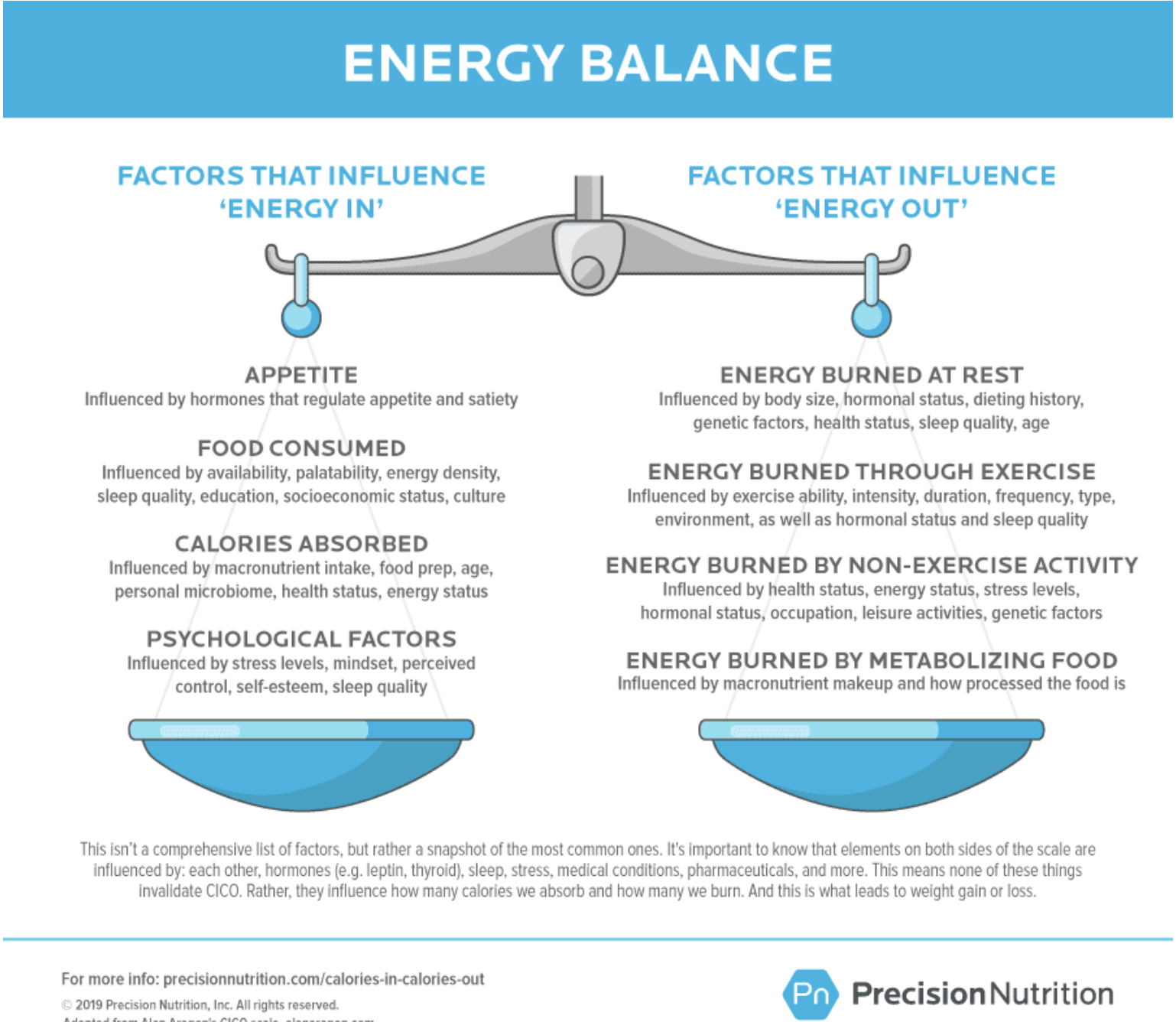
All calories DO matter. AND, there are lots of environmental, physical, and psychological factors that affect how much we eat and how much we move. I’ve always loved this infographic from Precision Nutrition showing all the hidden factors that go into the calories in, calories out equation.

So what’s the “right” strategy?

It’s the one that helps you influence that equation… sustainably.

Some people love tracking. Others hate it.

Some people do great with portion control, or high-protein meals, or reducing takeout.

None of that breaks the principle.

They’re just different tools for the same job.

For one person, tracking calories (the method) may help them be more mindful of their portions and food choices throughout the day. They start to plan ahead for meals, and this results in a slight and sustainable caloric deficit for them. They don’t hit everything perfectly, but over time, they start to see progress. For another person, tracking calories may completely backfire! It makes them feel neurotic and obsessive over the numbers. It’s really difficult to do, and even in the best of scenarios, tracking calories at home is not an exact science. After several weeks, they aren’t seeing progress and it makes the process feel miserable and demoralizing, not empowering. Both of these situations are normal and EXPECTED. We don’t all have the same bodies, the same environments, or live in the same situation!

In fact, once you realize this, it’s like taking the Red Pill in the Matrix. You can see the code everywhere, and apply this same thought process to ANY diet or method out there.

Keto. Paleo. Intermittent Fasting. For some people, these methods create the behavior changes that lead to sustainable differences in calories in, calories out. For others, they don’t.

So if you’ve ever had a coworker say: “I lost so much weight just doing X! You should try it!” And then you DID try it and it didn’t work for you – you’re not broken, it just wasn’t the right strategy for YOU at that time.

💡 The Bottom Line

Let’s stop debating whether the principle works.

Instead, let’s start asking:

What’s the best method for this individual person to put that principle into action, without burning out?

You don’t need to count every calorie.

You can count calories if it helps.

And you can absolutely make progress by focusing on the habits and behaviors that affect that equation in a sustainable way.

We put together our own TDEE calculator – which helps you ballpark the daily calories you need based on your activity levels. Steve and I also put together a guide on the 10 Nerd Fitness Nutrition levels – these are practical skills that are focused on behaviors first and foremost, for those that feel overwhelmed and aren’t sure where to start. Both are great tools in your fitness journey!

And if you want help figuring out what method fits your brain, your life, and your goals, I’m just a reply away.

– Coach Matt

The post The truth about calories in vs. calories out ⚖️ first appeared on Nerd Fitness.


from Nerd Fitness https://ift.tt/yaPMUQ0