VISIT FOR THE BEST FITNESS AND HEALTH ADVICES

Blog Archive

Wednesday, April 1, 2026

The 50/50 Rule (when training less is exactly the right call)


Ever wonder how to adjust your training when you’re sick? Or what to do if you haven’t worked out in a few weeks and are ready to get back into it? How about after you’ve just had a terrible night of sleep?

These situations come up all the time in our coaching program, so today, I want to walk you through the 50/50 Rule: my go-to strategy for helping people train safely and effectively when life throws you a curveball.

Let’s break it down.

The 50/50 Rule

Here’s the premise: do 50% of the total reps and 50% of the weight. (This nets you 1/4 of the total training load.)

Let’s say your workout calls for 2 sets of 10 reps with 20lb dumbbells. Applying the 50/50 Rule, that becomes 2 sets of 5 reps with 10lb dumbbells.

Another example – a bodyweight exercise like pushups, 4 sets of 6 reps. With the 50/50 Rule, that turns into 2 sets of 3 reps of an easier pushup variation.

Why it works

When your body’s resources are overstretched – from prolonged intense training, illness, or periods of high stress – pushing at the same intensity doesn’t produce the same results. You’re drawing water from a well that’s already depleted.

Coming off an illness or a prolonged break from training, your body is significantly more sensitive to training stimulus than normal. The threshold for “too much” is much lower than you think.

Have you ever jumped right back into your normal workout after being sick, felt great during it, and then been destroyed for days after? That’s exactly what’s happening.

The good news is you also don’t need as much, either. A reduced session still gives you real benefits – practicing technique, maintaining the habit, nudging recovery forward – without digging yourself into a deeper hole.

Think of it less as “going easy” and more as training at the right dose for where your body actually is right now.

Practical applications

  • Deload – If you’ve been training hard for 4-8 weeks without a break, take an entire week using the 50/50 rule. This gives your body extra time for rest and recovery so you come back stronger and ready to train. Note: if your training schedule is inconsistent, you’re already getting mini “breaks” built in, so you probably don’t need a dedicated deload week as much.
  • Illness – If it’s genuinely mild (no fever, no muscle aches, etc.), the 50/50 Rule can keep you moving while you recover (just don’t do it at the gym and get other people sick!). Coming off being sick, use it to ramp back in. Start at 50/50, then add 10-20% each session as long as you’re feeling good and recovering well.
  • Terrible Night of Sleep – Get in, do a 50/50 day, and go home. No need to white-knuckle your way through a full session. Hopefully you sleep better and return to full reps and weights later in the week.
  • Prolonged Time Off – Been a while since you worked out? Apply the 50/50 Rule to your first few sessions back. The goal is to get moving and feel good, not obliterate yourself.

The Takeaway

Training isn’t about going hard all the time no matter what.

The most effective approach is working out the right amount, in the right way, at the right time – and the 50/50 Rule gives you a simple way to do exactly that across a surprising number of situations.

Simple enough to remember, easy enough to execute, and it’ll serve your training and recovery for the long haul.

You got this. 💪

– Matt

P.S. Looking for practical, real-world advice without all the B.S.? That’s exactly what our coaching program is built on. ðŸ”¥

The post The 50/50 Rule (when training less is exactly the right call) first appeared on Nerd Fitness.


from Nerd Fitness https://ift.tt/IKmBq5g

NAWs: the art of getting back on track


I got a message from a reader, Sabrina, this week – and she pointed out a pattern I think a lot of us know well.

“I allow myself to say sliding into bad habits is alright. After all, I’ve had a bad day. Well, my bad days have a tendency to become hard weeks and then months. It doesn’t take much for me to backpedal.”

I know I’ve been there. 🙋‍♂️

Here’s how we work through it.

Know the difference between an off-day and a repeated pattern.

Missing a workout or having a meal that’s not strictly on plan? Totally fine and expected. It’s not going to hurt your progress.

The problem isn’t the slip. It’s when the slip becomes the default.

Give yourself some grace on the hard days. And stay honest with yourself: is this a one-off, or a pattern forming? If it’s a pattern, call it out and reroute.

Rethink what taking care of yourself actually looks like.

Sometimes the perfect recovery from a hard day is to Netflix and chill. Rest absolutely counts as self-care.

But so does the workout you’ve been putting off, a solid meal, or putting down your phone and getting to bed at a reasonable hour.

Sometimes the most caring thing you can do for yourself is the thing you’re avoiding.

A hard day doesn’t have to mean opting out. It might mean doubling down on the things that you know are good for you.

Don’t try to play catch-up.

This is one of the most common traps I see. Someone misses a workout and suddenly feels like they need to do that one PLUS today’s to make up for it. That’s how you end up feeling like you’re pushing a boulder uphill before you’ve even started.

Forget what you missed. Focus on the plan for today. Do that. Then build from there.

Find your NAW (your Next Available Win).

When you realize you’re off track, the instinct is to overcommit.

“I need to work out five times a week.”

“I need to do a giant meal prep and reset the whole kitchen.”

Those things aren’t wrong, but they’re not your first step.

Your first step is the next available win. One thing that interrupts the current pattern.

Maybe it’s five minutes of stretching on the floor while you watch TV tonight. Maybe it’s grabbing some fruit as a quick snack.

Here’s the key: you don’t have to wait until tomorrow, or Monday. Reset the pattern as soon as possible.

I recently had a client come back from vacation feeling completely off track. We didn’t map out an elaborate return plan. We just asked one question: “OK – when’s the next workout?”

The next day she knocked out a short workout and hit a PR on her barbell rows.

That’s all it took. The next available win. (PR not required 🤪)

The next time you catch yourself having an off-day, start with grace. These days are normal, expected, and they don’t erase all the hard work you’ve put in.

Then check in with yourself: “Am I falling into a pattern that’s working against me? If so:

  • Reframe what self-care looks like
  • Don’t play catch-up
  • Find your NAW

Save this for the next time you need it:

You got this. 💪

– Matt

P.S. If you’re in a backslide right now, we’re here to help. Take our Coaching Quiz to find your own personal fitness Yoda.

The post NAWs: the art of getting back on track first appeared on Nerd Fitness.


from Nerd Fitness https://ift.tt/HJCo2ip

Struggling with nighttime snacking? Try this instead.


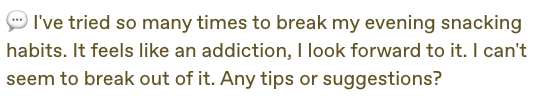
I got a question from a reader named Rick this week:

If this sounds familiar, you’re definitely not alone.

When people join Nerd Fitness Coaching, over 70% tell us they struggle with stress eating, emotional eating, or nighttime snacking.

I recorded a short video explaining why simply “trying to stop snacking” usually backfires – and what tends to work better.

WATCH: STRUGGLING WITH NIGHTTIME SNACKING? TRY THIS INSTEAD

If you’d rather read than watch, here’s the short version:

1. Eating at night isn’t the problem.

If you genuinely need more calories or nutrients for the day, eating at night is completely fine! (Contrary to popular belief.)

The challenge most people run into is when they find themselves snacking even when they’re not hungry, often as a way to decompress after a long day.

2. Going cold turkey rarely works.

If nighttime snacking has become your main way to relax or reward yourself at the end of the day, simply removing it often leaves a gap that’s hard to sustain.

3. Build a “decompression menu.”

Instead of trying to eliminate the habit immediately, come up with a few other things you genuinely enjoy that help you relax at the end of the day.

Examples might include:

  • making herbal tea
  • reading
  • stretching
  • listening to music
  • playing a game
  • journaling

Even if you choose one of these alternatives some of the time, that alone can start shifting the habit.

The goal isn’t quit snacking at night, forever!

It’s to understand the habit and expand your choices. 💪

4. Upgrade your Batcave to make the alternative choice easier.

At the end of the day we’re usually tired, and that’s when we tend to default to the easiest and most familiar option.

A few small changes to your environment can make a big difference.

Things like keeping your go-to snack foods out of immediate reach, or setting out your book in a visible and easy to access place.

Heck, you could even try putting your book IN the pantry where the snacks usually are!

The goal is to rely less on willpower and more on an environment that gently nudges you in the direction you want to go.

So Rick, if you’re reading this, that’s where I’d start.

Instead of trying to eliminate the nighttime snacking overnight, experiment with adding a few other ways to decompress and adjust your environment so those choices are the easier ones.

Try it for a week or two and see what you notice.

Then we learn and adjust from there. 🔥

– Matt

P.S. If you want to submit a question like Rick, you can!

The post Struggling with nighttime snacking? Try this instead. first appeared on Nerd Fitness.


from Nerd Fitness https://ift.tt/98ARagC