VISIT FOR THE BEST FITNESS AND HEALTH ADVICES

Blog Archive

Friday, October 3, 2025

3 things we’ve learned in 8 years of coaching


Note: Make sure to read to the end for an important update about Nerd Fitness Coaching!

Over the past 8 years, we’ve had thousands of conversations with clients, Rebels, and community members.

We’ve run polls, read replies, and listened closely to what people struggle with.

Again and again, variations of three statements kept coming up.

  • “Just tell me what to do.”
  • “I need to see signs of progress.”
  • “I can’t seem to stay motivated.”

Each of these reveals an underlying pitfall I see people fall into, and I want to help you avoid making the same mistakes!

“Just tell me what to do.”

Pitfall: overly restrictive plans that leave you burned out

Need: clarity that fits your life

People I talk to feel overwhelmed and overloaded.

They already have a ton on their plate with work, family, and other responsibilities.

It’s no wonder there’s a strong desire for someone to just simplify things!

But it backfires when it leads to plans that aren’t a good fit for your life.

Exercises that aren’t the right level, restrictive meal plans, and schedules that assume you have all the time and energy in the world just leave you burned out and back at square one.

We’ve learned to emphasize fit and flexibility first.

That way, you get clarity on next steps while also making sure there’s enough flexibility to make it a good fit for you. ❤

“I need to see signs of progress.”

Pitfall: jumping from one program to the next

Need: multiple levels of feedback loops

Change is hard.

And it’s even harder if it feels like you’re spinning your wheels and not getting anywhere! I bet a lot of us have started a new workout, or a new nutrition program, only to step on the scale or look in the mirror and feel deflated and like nothing is happening.

That can lead to program hopping – jumping from one thing to another so quickly it’s hard to evaluate their effectiveness.

Fitness is like investing: the biggest returns take time!

So here’s how we tackle that: we track both effort AND results.

  • Effort: workouts completed, habits practiced, consistency
  • Results: strength gains, body composition, moving through your day more easily, sleep quality, energy levels, etc.

Wins in consistency are an early form of progress. They are the first step in evaluating whether a program is a good fit for you.

Wins in results come later, but are still important to consider when evaluating any changes that need to be made.

Some tools we love to accomplish each of these:

  • Jar of Awesome (effort): every time you make a choice you’re proud of, add a marble (or note) to the jar. Watch the wins stack up.
  • Zoom Out sessions (results): set a rhythm (we recommend every 2-6 weeks) to evaluate your progress. This prevents you from adjusting things too quickly while also giving you clear check-in points to make changes.

Having feedback loops in each of these areas makes it easier to stay confident and patient. 🙌

“I can’t seem to stay motivated.”

Pitfall: all-or-nothing thinking

Need: systems that support consistency

This is the big one. Life gets messy. People get sick, work runs late, chaos happens.

It’s easy to get knocked off course and blame ourselves and our lack of motivation for being unable to see things through.

This leads to a lot of all-or-nothing thinking.

Either we are all in (and things are going great!), or we get knocked off course and struggle to get back on track.

Here’s how to avoid that pitfall:

The more you practice implementing these systems, the easier it will be to maintain momentum. 💪

Quick checklist

When you look at your own plan, ask yourself:

1. Does it give me clarity that actually fits my life?
2. Do I have feedback loops to track effort and results?
3. Do I have systems to help me stick with it when life gets messy?
If yes…AWESOME! You’re set up for success.
If not…no worries. Start with whichever one feels weakest, and shore it up first.

And if you’d like help implementing these strategies, now is a great time to join Nerd Fitness Coaching!

For the first time in 8 years, we’ll be raising prices for new Nerd Fitness Coaching clients after October 31, 2025.

Current clients are not affected.

Starting November 1, the base monthly rate will increase from $197 to $297.

The change reflects 8 years of improvements we’ve made as a program, continued investment in our custom app, and our commitment to hiring and retaining the best coaches in the galaxy. 🤘

If you’ve been thinking about joining, you can still lock in the $197/month rate if you sign up by Friday, October 31, 2025.

Our team would love to chat with you to see if coaching is the right fit!

-Matt

The post 3 things we’ve learned in 8 years of coaching first appeared on Nerd Fitness.


from Nerd Fitness https://ift.tt/JszGmqF

Friday, September 12, 2025

4 Workout Strategies for Busy Parents


I got this message the other week, and it felt so. Freaking. Relatable.

…the biggest challenge right now is that I am a full-time working mother of two young boys and I’m just so freaking exhausted.

I’m on a hamster wheel of life right now, giving of myself to everyone and everything around me.


It’s not just that it’s hard to find the time to work out…it’s hard to find the energy.

It’s also hard to create a routine I can stick to, one that I can just do without thought, given all the variables in my life.”


Parenting young kids is an especially challenging period of time. There’s a ton of variability in your routine, high demand on your time and attention, and not a lot of energy to spare.

Whether you are a parent, a caretaker, or just going through an incredibly busy season of life, trying to add a fitness routine on TOP of everything else can feel like the Jim Gaffigan joke: “You know what it’s like having five kids? Imagine you’re drowning. And then someone hands you a baby.”

We hear this sentiment all the time with clients in our coaching program.

So today, I want to walk you through exactly how I help them navigate this intense period, while still finding time to work on their health and fitness in ways that feel sustainable to them.

And continuing the “Matt stands in front of a white board in his office and records a video” experiment, I’ve got an accompanying video with notes so you can digest this in whatever format works best for you. ❤ (Bonus points to anyone who recognizes where my T-shirt is from!)

And if you are someone who struggles to find consistency with your workouts, reply to this email! I’d love to see how I can help. 💪

The Key Challenges

If you tell me you’re a parent, then I can immediately predict a few things:

  • Highly variable schedule
  • High demands on time and attention
  • Lack of predictable routine.
  • (Periods of) low energy

I still remember talking with Mike (host of The Chasing Scratch Podcast), and how he kept saying: “This week is crazy, but NEXT week, things will finally get back to normal.”

After several weeks of this, I stopped him and said something along the lines of: “I think unpredictability IS the only predictable thing.”

Our mantra became “There is no normal”, and that’s been key to his success in getting 148 workouts in so far this year (and counting!)

The Strategies

Dial Mode

If we know each day is highly variable, then our plan needs to take that into account.

Start by creating a short and simple bodyweight workout you can do in 5-15 minutes. (Like doing 1 round of this workout.) It becomes a key puzzle piece you can fit into a crazy day.

When I worked at Force Fitness, I remember coming in after a long night with the kiddos, feeling absolutely dead to the world. On these days, my boss and I would look at each other and say: “Turkish Get-Ups and Farmer’s Carries?” Two movements to just get us up and moving for a few minutes, and then cash out for the day.

Accumulation

Workouts don’t need to happen all at once. You can break up the workout into mini-sessions across the course of the day or even week!

The more important factor is getting the work done, not in the timing. 💪

This is exactly the strategy I use with new parents. We write out a list of exercises, and a target number of reps to get done across the week. Then, they squeeze them in as they can. If you’d like an example of what this looks like, shoot me and email and I’d be happy to share some!

Me Time

Sometimes, it’s really important to try to carve out time in your schedule to focus on just you. That may mean asking a partner for help, or making some tough decisions about trade-offs. It’s not always possible, but it’s still worth considering.

That’s what we did with my client Michelle. She was having a hard time fitting in workouts, so we walked through some tradeoffs she could make. She asked her partner for support, and was able to carve out 20 minutes after work. She would park outside, and do a workout in the garage. She wasn’t “home” until she walked through the garage door.

I Go, You Go

If you can’t beat them, join them! Invite the kiddos to participate with you.

Switch your focus to more skill-based or play-based training that may be more engaging for them. Instead of optimizing for “results”, optimize for fun and connection.

This is the option that has been most meaningful in my own life. Part of my big why is connecting with others, and modeling healthy behaviors for my own kiddos. While I still like working out alone, too, finding more ways to involve my family has made the journey all the more rewarding. ❤

For more ideas on games you can introduce to your kids, check out this article and this article.

Want to try your hand at Parkour (in a safe and effective way?) I got you! 🙌

And there you have it! If you were my client, I’d walk you through these similar steps

  1. We’d lay out your current schedule and the very real challenges involved.
  2. We’d figure out which strategy fit best for you.
  3. Then I’d write workouts and provide accountability to take the thinking off of your plate and help you stay on track. 💪

Whether you’re a busy parent, or just someone going through a hectic period in life right now, give these strategies a try and let me know how it goes!

– Coach Matt

P.S. Interested in Nerd Fitness Coaching? Book a call this week and mention “Rebellion” for $50 off your first month of coaching. We have no contracts, no hidden fees, and you can cancel at any time. We only want you to stay if it’s ACTUALLY working for you!

The post 4 Workout Strategies for Busy Parents first appeared on Nerd Fitness.


from Nerd Fitness https://ift.tt/XfaQOxy

Wednesday, September 3, 2025

What to do when fitness feels like a chore…


For most of my adult life, I’ve been a full-time fitness professional.

But I have a confession to make.

Fitness can feel like a chore.

That’s right, even “professionals” don’t always feel motivated. And neither do my clients.

That’s normal. Nobody feels motivated all the time.

Fitness is kind of like flossing. You don’t always love it, but you know it’s important.

So what do you do when it all just feels like another item on your ‘to-do’ list?

First, give yourself permission to feel this way.

You don’t have to be someone who “falls in love” with fitness for it to matter. Even if you never totally look forward to it, a little consistent effort still pays off.

Second, when possible, it is worth trying to bring more joy to the process.

At its best, fitness isn’t the end goal. It’s the amplifier for everything else you love.

If fitness is feeling like a chore for you right now, here are a few ways to mix things up:

1. Theme it.

Name your workouts after your favorite hobbies or interests. (If you love Star Wars, you aren’t working out, you’re doing Jedi Training.)

You can try a workout specifically built around something you enjoy or even one that levels up after boss battles.

And this doesn’t just go for workouts!

There are tons of themed cookbooks out there too to inspire and bring some fun to your meals.

My son (11) brought home a Minecraft Cookbook from school last week, and decided he wanted to make “Minecraft Steak”. It was literally just steak with salt and pepper on it, but he was so excited and invested in getting the meal juuuuuust right.

You can even add some flavor to how you track your progress.

Bottom line: Whatever the thing you love, whether it’s Gandalf, gardening, or golf – see if you can bring a bit of that into the mix.

2. Tie it back to life outside of fitness.

For most of us, fitness isn’t about being the “best at fitness.” (Though if competing in 5k runs or powerlifting events is what you love, that’s awesome, too!)

It’s about having the energy and health to show up in the things that light you up. For example, one of my clients, Julie, really hated strength training. She knew it was important for muscle retention and bone health and all the rest. But it wasn’t until we were able to tie specific movements in her workouts back to her passion, archery, that the “chore” part of working out became easier to do.

I still remember how she lit up after she came back from an archery session and said something along the lines of: “the bow just felt so easy to pull!” (Archery people, don’t come at me if I butchered that. 😅 )

Bottom line: Highlighting the connection between your fitness goals and all the other cool stuff you love to do is a cheat code.

3. Add games + challenges.

Movement doesn’t always need to be serious.

Try adding some more games and mini-challenges to your session to spice things up!

Finish your warm-up with the Stick Drop Challenge.

In between exercises, add in some low intensity movements like juggling, or walking on a balance beam, etc. to give your brain a challenge even while your body is recovering.

Roll a D20 to determine what your conditioning will look like at the end of your session.

At Camp Nerd Fitness, my ninja class was full of little games and challenges like these, and people left smiling and sweaty. I remember one camper in particular, Emily, coming up to me and giving me a big hug afterwards because this approach made fitness feel fun and accessible in a totally new way.

Bottom line: where possible, tap into the playful side of movement.

4. Keep it simple.

Sometimes, despite all that, fitness will still feel like a grind.

That’s OK.

In those seasons, don’t overcomplicate it. Focus on the basics: a few key movements, eating some protein, moving a little each day.

Action matters more than perfection.

Some of these ideas will click, some won’t, and that’s the point. There is no one size fits all prescription here for everyone.

My hope for you is that you can find ways to make fitness feel additive to your life, without taking it over.

So let me ask you:

What would bring more joy into your fitness right now?

Hit reply and let me know – I’d love to hear it.

–Matt

The post What to do when fitness feels like a chore… first appeared on Nerd Fitness.


from Nerd Fitness https://ift.tt/2iAUgRN

Thursday, August 14, 2025

Tip for tackling emotional and stress eating 🍎


A couple of weeks ago, a reader sent me this question:

I exercise regularly, but I still struggle with stress eating. Where and how do I start to tackle this?

Chances are, you can relate. How do I know? 1) You’re human. (Unless you’re a robot… in which case: hi, and please don’t turn us into batteries like in The Matrix 👋)

2) When we work with clients, they fill out an intake questionnaire so we can learn more about them, their goals, what their biggest challenges are.

Emotional and stress eating is the most common challenge our clients report coming in – more than time, motivation, or even not knowing what to do.

If anything, eating when we feel stressed is the thing that most of us have in common!

Emotional eating and stress eating are complex behaviors, and they show up for a lot of people in different ways. While I’m not a therapist or a registered dietitian, I can share some patterns and strategies we’ve seen help others as part of our coaching work at Nerd Fitness.

That said, if these behaviors feel especially intense or overwhelming, I want to acknowledge that working with a licensed mental health professional (especially someone trained in disordered eating) can be really valuable. Therapy can be a game-changer here, and our coaches often work in tandem with therapists to make sure our work is supportive of what they do. ❤

With all that said, let’s explore a few practices within our coaching scope that we’ve seen help. 🙌

1. Notice and Name

One of the most powerful things you can do is just pause and notice what’s going on when you find yourself eating reflexively.

Is it stress? Exhaustion? Boredom? Frustration? Hunger? Just because it’s that time of day?

This isn’t about stopping the behavior immediately – just becoming more aware.

I’ve literally had people say it out loud how they are feeling in the moment: “I just had a stressful interaction with my colleague, and my instinct is to reach for something crunchy.”

Once we’re better able to understand our behaviors, we can use some of the other strategies we’ll discuss to help.

Though sometimes, this step alone is enough! I remember my client Liz telling me this single practice was so powerful, it helped her reroute her behaviors in a way that felt good to her (even though that wasn’t the intention!)

2. Proactive Self-Care (a.k.a. Your Nourishment Menu)

A lot of emotional eating stems from unmet needs – fatigue, loneliness, stress, overstimulation.

That’s why we recommend building a “nourishment menu”: a list of small, intentional activities that help you recharge. Reading, stretching, journaling, walking outside. Whatever genuinely helps you.

Pick one thing from that list each day to practice proactive self-care.

My client Mark often found himself reaching for snacks at the end of the day while he was watching TV, even though he didn’t technically feel hungry.

We realized that part of the trigger for him was a feeling like he didn’t get any time to himself throughout his hectic day, and so having this decompression time at the end of the night was important to him.

Whenever he tried to just fight through with “discipline”, it would backfire and he couldn’t sustain it.

It wasn’t until we made time for small pockets of other recharging activities earlier in the day that the underlying need was met, and stress eating at the end of the day was easier to change.

3. Use “Always” and “Sometimes” Language

A helpful reframe we often use: instead of labeling foods as “good” or “bad,” think of them as “always” or “sometimes” foods.

“Always” foods support your goals and energy consistently. These are things you want to include regularly in your meals and snacks.

“Sometimes” foods are still great options to enjoy, we just choose to eat them with less frequency than our “all the time” foods.

The key here is: no foods are off the table, permanently.

A lot of times, I hear people say stuff like: “I’m going to finish off this pint of ice cream left over in the freezer, and then it’s NO ICE CREAM FOR ME!”

While I know it’s well-intentioned, this ends up backfiring in almost every case.

While we want to be realistic about the types and amounts of foods that support your goals, we ALSO want to build a healthy relationship with food that doesn’t moralize it as “good” versus “bad”.

And this reframe can help.

4. Introduce an Interrupt Step

Next, it’s time to experiment with an interrupt step.

If you notice a strong urge to eat in response to stress, try inserting a small pause. We usually recommend finding something else to do for five minutes.

This could be going for a short walk, listening to music, tidying up your workspace, whatever.

Then, you can ask yourself:

“Am I physically hungry, or is something else going on?”

Sometimes that pause is enough to reroute the urge, or at least bring some awareness to what’s driving it.

Then you can make a conscious choice instead of reacting on autopilot.

Then we learn and build from there.

If stress eating is something you’ve struggled with, you’re not alone (and we have the data to prove it!)

And if you’re not sure where to start, pick one step from the list above and see how it feels.

You’ve got this.

–Matt

P.S. We’re hiring! We’re looking for a marketing specialist to join our team and work closely with me!

If you’ve got the experience and drive to help us make a difference in the fitness industry, please check out the link and consider applying. ❤ 

The post Tip for tackling emotional and stress eating 🍎 first appeared on Nerd Fitness.


from Nerd Fitness https://ift.tt/FpKn8G5

Thursday, August 7, 2025

The truth about muscle loss while dieting 💪


There’s a chart I want to show you today.

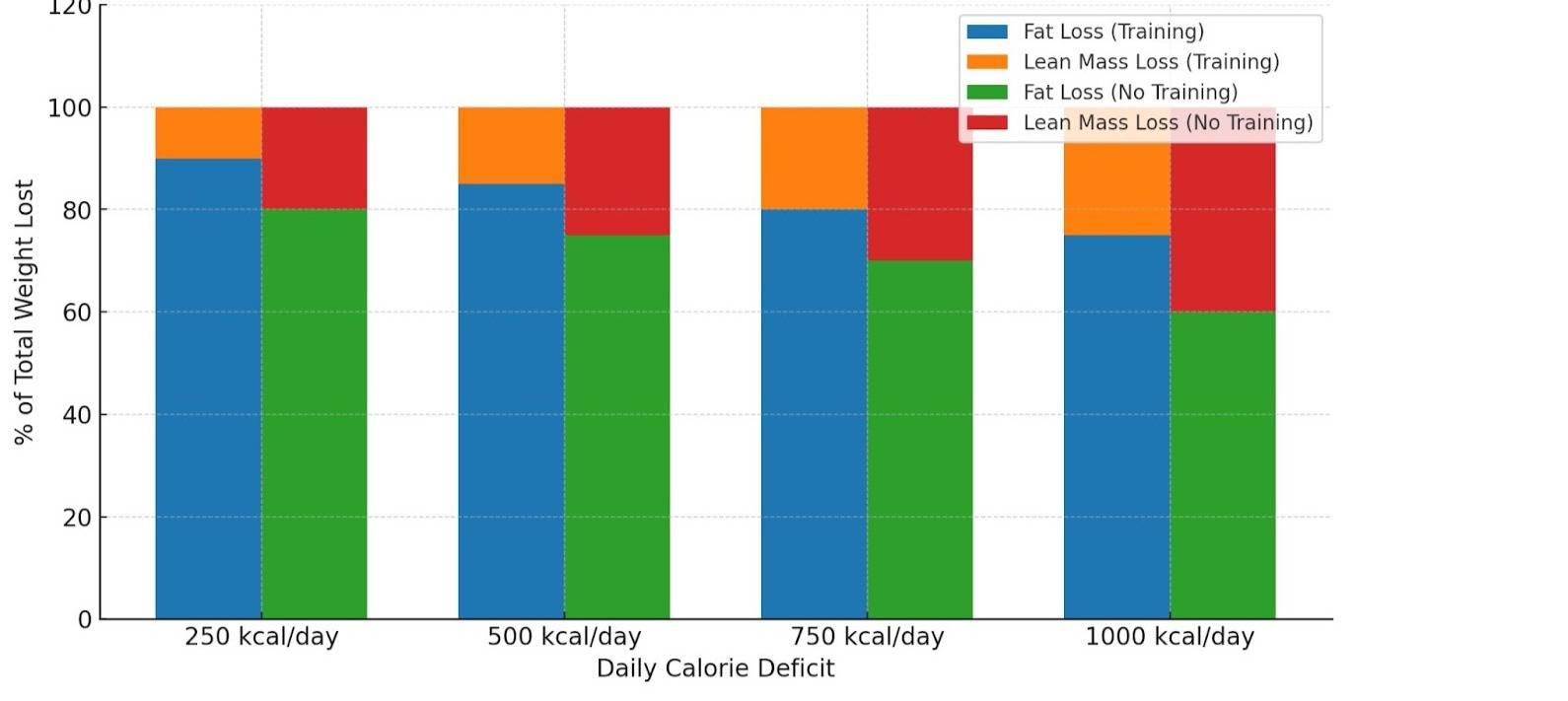
It shows the percentage of fat vs. fat-free mass lost at different levels of calorie deficit, depending on whether you’re strength training or not. (You’ll find it below.)

It also sheds light on one of my LEAST favorite trends I see in the fitness industry today: making sweeping statements without any context.

And with the rise of GLP-1 medications like Ozempic and Wegovy, I see this one popping up all over the place:

“If you don’t eat enough protein and lift weights, you’re just losing all of your muscle.”

We’ll get into it, but extreme statements like this are just wildly unhelpful, and miss so much of the important nuance.

Is strength training useful when you are on these medications or a calorie deficit in general? Yes.

But if you listen to the general chatter on the internet (never really a good idea), it makes it sound like muscle is literally falling off of your body with each step you take. And that’s not only fear-mongering, it’s just not true.

Let’s zoom out:

I want to break down what’s actually happening in your body so we can have some real talk about the different tradeoffs involved.

✅ If you’re in a calorie deficit, you’ll lose weight
✅ Whenever you lose weight, there is always some amount of loss of lean mass. (I.e. stuff other than fat)

✅ Strength training and eating higher amounts of protein can help you preserve more of your muscle mass while in a caloric deficit

✅ The larger your deficit, the more lean mass you tend to lose regardless of what you do.

✅ And GLP-1s don’t change that – they just help people stick to larger deficits than they might otherwise.

So to recap, whenever anyone in the history of forever has lost weight, some of that has come from lean mass.

The larger the caloric deficit you are in (i.e. the faster you are losing weight), the greater the percentage of that weight will come from lean mass. This is totally normal and expected.

Strength training and eating higher amounts of protein can absolutely help you preserve more of your lean mass. But you’re not going from “losing all muscle” to “losing zero muscle.” These changes are degrees, not all-or-nothing.

How much of a difference can training and eating more protein make?

I’m so glad you asked!

Here’s a chart that shows on average where we expect weight loss to come from. (Individual results will vary based on genetics, type of training, diet, etc.)

In general, strength training helps preserve an extra 10-15% of lean body mass.

So, for example, if you lost 10 pounds over the course of 3 months on a 500 kcal/day deficit, you’d expect around 2.5 pounds of that to be from lean mass if you weren’t training, and 1.5 pounds of that to be from lean mass if you were training (I.e. a 1 pound difference.)

Why this matters:

I see so many people get discouraged because they feel like they’re not “doing it right.”

Maybe they’re not strength training yet.

Maybe they haven’t figured out how to hit their protein goals.

Maybe they’re just trying to stay consistent with any part of the process.

And they start hearing things like:

“You’re just losing muscle.”

“You’re ruining all your progress.”

“You’re doing it wrong.”

But in reality? You’re just making a trade-off.

As an example, maybe a slight caloric deficit with no strength training is easier for you to maintain than a much higher deficit with strength training added in. Sure, it may take longer to see the weight loss – but the ratio of fat free and fat mass is essentially the same in each of these scenarios.

Or maybe you consciously go on a larger caloric deficit for a short period of time, and follow that up with a more focused muscle-building phase to rebuild some of that lean mass. That’s another viable strategy.

The point is: if we can cut through the fear mongering and wildly overblown statements, we can have an actual discussion about what’s the best choice for you based on where you’re at currently.

Real talk from a coach:

If you’re just getting started and weight loss is your goal, focusing only on staying in a modest calorie deficit might be the best move.

That alone can help reduce joint pain, improve energy, and boost confidence.

Then once that’s solid? Add in strength training.

Then protein.

Then maybe some walking or sleep habits.

You don’t have to do everything, everywhere, all at once to be successful.

In fact, most of the people we work with find success by building a foundation and then adding to it – one habit at a time.

TL;DR:

  • Yes, eating enough protein and lifting weights will help you keep more muscle.
  • Bigger calorie deficits = more muscle loss, even if you’re doing everything else “right.”
  • But these are degrees, not disasters.
  • Focus on what you can do.

Want to chat about how to apply this to your plan? Just hit reply and let me know.

You’ve got this.

-Matt

The post The truth about muscle loss while dieting 💪 first appeared on Nerd Fitness.


from Nerd Fitness https://ift.tt/sn1EqbY